
Piano Music Festival
Branding, creative direction, and communication to transform a festival into a recognizable identity.
The Piano Music Festival grew out of Piano Went Crazy, a concept created in 2024 by Alessandro Tacchini to bring an electronic music event to the area—one inspired by major international festivals but deeply rooted in Lake Piano and its nature reserve.
My journey began with the design of the Piano Went Crazy logo and continued with the launch of the festival. I handled branding, creative direction, social media strategy, storytelling, and communication materials, while also contributing to the development of several organizational ideas.
The goal was to build a communication strategy capable of engaging the audience for six months, generating anticipation, brand recognition, and an identity destined to evolve with each edition through an ever-changing graphic concept.
Months of communication
6
Content Created
74
Instagram Views
660.088
Festival Participants
1.137

Building an identity, not a poster
The communication campaign for the Piano Music Festival was not designed as a simple promotion, but as a journey meant to guide the audience all the way to the day of the event. Each piece of content played a specific role within a broader strategy.
Over the course of six months, the campaign unfolded according to an editorial plan that alternated between informative, emotional, and narrative content. The festival was revealed bit by bit, keeping curiosity high and progressively strengthening the brand’s identity.
Rather than a mere sequence of graphics, a coherent communication system was built, in which the color palette, typography, composition, and visual language made every piece of content instantly recognizable.

Identity Takes Shape
The visual identity of the first edition draws its inspiration from the local area. Lago del Piano, the vegetation, and the colors of the nature reserve inspired the graphic concept, making green the defining element of the entire communication campaign.
Based on this idea, color palettes, typography, textures, and graphic effects were developed, creating a visual language capable of conveying the energy of an electronic music festival while maintaining a connection to its host location.
The official cover became the starting point for the entire project: not just a simple poster, but the foundation upon which all of the festival’s communication was built.

A system, not a collection of posts
Once the visual identity was defined, the next step was to transform it into a communication system capable of guiding the audience throughout the campaign.
Each piece of content had a specific goal: to inform, to evoke emotion, to build anticipation, or to tell the story of the festival. To keep the communication dynamic, an editorial structure based on recurring formats was developed. Artist profiles, emotional posts, informational content, and storytelling alternated according to a precise plan, while consistently maintaining the same visual identity.
The result was a narrative built over the course of six months. More than just a series of posts, an ecosystem of content emerged that strengthened the identity of the Piano Music Festival and fueled anticipation leading up to the day of the event.

Introducing the Artists
The lineup is one of the most important elements in a festival’s communication strategy. For this reason, each DJ was presented using a dedicated format designed to highlight their identity while remaining consistent with that of the Piano Music Festival.
Each graphic incorporated elements from the main visual identity, adapting them to the artist’s colors and imagery. This made it possible to create instantly recognizable content, striking the right balance between the DJ’s personality and the festival’s identity.
More than just simple announcements, these posts helped build anticipation, guiding the audience as they discovered the lineup and reinforcing the event’s value with each new post.

Communicating Emotions
Alongside the informational content, posts were created designed to convey feelings rather than just facts. Short, impactful phrases, paired with evocative images, captured the festival’s atmosphere even before it began.
This content was intended to keep attention engaged between posts, fueling curiosity and engagement without directly mentioning dates, times, or artists.
Alternating between emotional and informational content made the communication more varied and engaging, transforming the feed into a narrative that evoked the festival experience.

Covering the Festival
A festival isn’t just about music. That’s why we created content dedicated to the different areas of the event, such as the PWC Room, food, services, and spaces designed for the audience.
Each post was designed to highlight a specific aspect of the experience, while consistently maintaining the same visual identity. This allowed the audience to discover the festival bit by bit, gaining an understanding of its organization and atmosphere.
This content helped build a comprehensive picture of the event, showing that the Piano Music Festival was much more than just a lineup.

Informing the public
Effective communication must also be useful. For this reason, content was created specifically for parking, access, maps, and practical information, designed to simplify the participants’ experience.
The goal was to make all information immediately understandable without compromising on graphic quality. Even the service-related content was designed in line with the same visual identity as the entire campaign.
In this way, even the most practical aspects helped reinforce the festival’s brand recognition, maintaining consistency between communication and organization.

A countdown that tells a story
The countdown wasn’t conceived as a simple sequence of numbers. The goal was to transform the last ten days leading up to the festival into a visual narrative that would guide the audience all the way to the event.
Each post represented a stage of the journey: from the natural scenery of Lake Piano to the trails, from the bike path to the festival entrance, and finally to the stage. A symbolic journey of a young woman that connected the local area to the festival experience, building anticipation day by day.
This format made the countdown a distinctive element of the communication strategy. Rather than simply reminding people of a date, it invited the audience to already feel like part of the festival, transforming the wait into an experience to be savored.
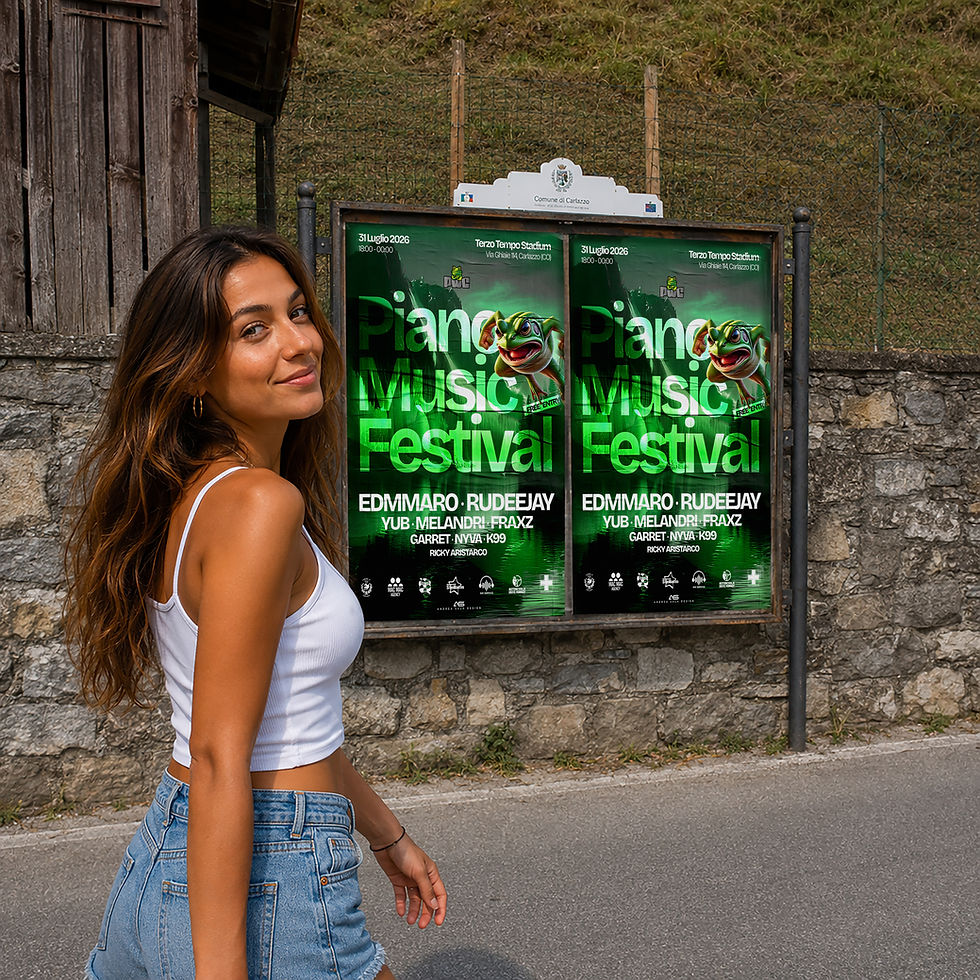
From the Digital World to the Local Community
The communication didn’t stop at social media. To strengthen the festival’s presence in the local area, the visual identity was also adapted for print materials, maintaining the same graphic consistency developed throughout the campaign.
Posters, flyers, and banners were designed to be instantly recognizable, adapting the concept to different formats without losing its visual impact. Each medium helped ensure the festival’s presence even beyond the screen.
The goal was to create continuity between online and offline communication, offering the public a recognizable identity at every point of contact with the Piano Music Festival.

The Day of the Festival
After six months of communication, the day of the event marked the moment when the entire project came to life. The identity built over the preceding months was transformed into a real experience, shared by the audience at the festival.
Every element highlighted during the campaign—from the artists to the dedicated areas, to the amenities and the atmosphere—was reflected in the event, creating continuity between what had been communicated and what people actually experienced.
The Piano Music Festival demonstrated how a methodically designed communication strategy can do much more than simply promote an event: it can build an identity, generate anticipation, and leave a lasting memory that endures even after the last note has faded.
Beyond Graphics
Every project tells a story. The Piano Music Festival demonstrates how a consistent visual identity, a well-defined strategy, and communication built over time can transform an idea into an experience that engages people. This is the approach I bring to every new project.


Collaborations


"Working with Andrea on the Piano Music Festival was much more than just entrusting him with the graphic design. From the very beginning, he was able to transform our ideas into a strong and recognizable visual identity, overseeing every detail of the project: branding, social media communication, print materials, and creative direction. Every piece of content published had a specific purpose and helped build anticipation for the festival. The countdown, the artist announcements, and all communications were carefully crafted, successfully conveying the event’s atmosphere even before it began. I especially appreciated his ability to propose ideas, find solutions, and always think with the big picture in mind, without limiting himself to just the graphic design aspect. He is a professional who works with passion and precision and who knows how to become an integral part of the project. We will definitely continue to collaborate on future editions of the Piano Music Festival."
Alessandro Tacchini
Founder Piano Music Festival
